
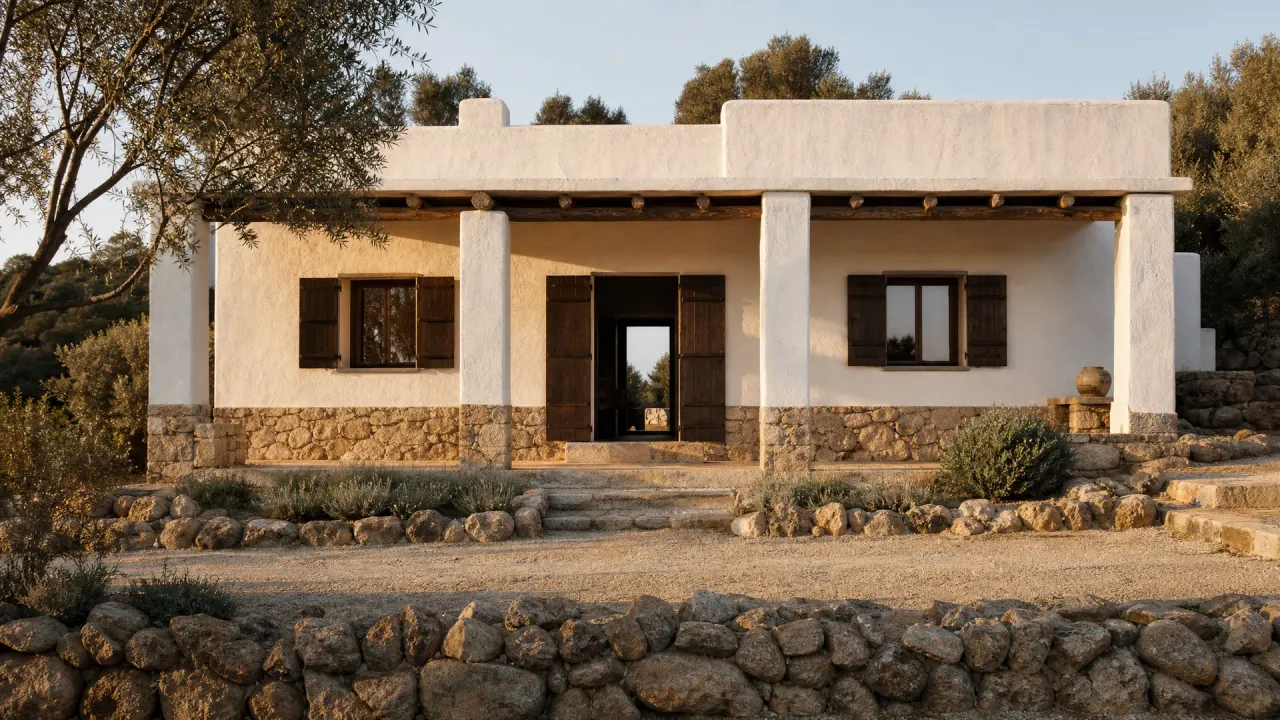
Lime-washed walls are walls finished with a thin coat of slaked lime mixed with water and natural pigment. Used continuously around the Mediterranean for thousands of years, lime wash breathes, regulates humidity, resists mould, and ages handsomely — qualities that modern acrylic paint cannot match. It is currently returning to high-end residential architecture as clients prioritise material honesty and low-VOC interiors.
At La Kruz Atelier we specify lime wash and lime plaster on nearly every rural Mediterranean project we deliver. This guide is the answer we give clients who ask why — what lime wash actually is, what it does that paint cannot, where it is appropriate, what it costs, and how to live with it once it is on your walls.
What is lime wash?
Lime wash (also called limewash, calcimine, or whitewash) is a wall finish made from slaked lime — calcium hydroxide produced by burning limestone, then quenching the resulting quicklime with water — diluted with more water and tinted with natural mineral pigments. It is applied in three to five thin coats and cures by reacting with carbon dioxide in the air, slowly turning back into a hard layer of calcium carbonate — chemically the same compound as the limestone it came from.
This is the central thing to understand: lime wash is not a coating sitting on top of the wall. It chemically becomes the surface of the wall. That is why it behaves so differently from acrylic paint, which forms a polymer film over the substrate.
How is lime wash different from paint?
Six differences matter in practice.
- Breathability. Lime wash is highly vapour-permeable. Water vapour travels freely through it. Acrylic and alkyd paints are largely vapour-impermeable; they trap moisture in masonry walls and cause salt efflorescence, paint blistering, and over time deeper damage to the substrate.
- Humidity buffering. Lime plaster and lime wash genuinely absorb and release moisture across the day, dampening interior humidity swings.
- Mould resistance. The high alkalinity of cured lime (pH around 12 immediately after application, settling around 8 over months) is hostile to mould and bacteria. This is the reason traditional dairies, kitchens, and stables were lime-washed annually.
- Patina, not failure. Lime wash erodes very slowly and unevenly. The areas exposed to weather lighten and powder; sheltered areas stay denser. The wall develops the soft, cloudy, layered look that no paint product genuinely imitates.
- VOC profile. Properly made lime wash is zero-VOC. It carries no plasticisers, biocides, or fungicides.
- Carbon footprint. Producing slaked lime releases CO₂, but the carbonation phase as the lime cures reabsorbs much of it. Net embodied carbon is roughly half that of an equivalent acrylic paint over a building life.
The trade-off: lime wash is softer than paint, less colour-stable in saturated tones, and incompatible with some modern substrates. It is the right answer for some buildings and the wrong answer for others.
Where does lime wash work — and where doesn’t it?
Lime wash works on porous, mineral substrates: lime plaster, lime-render, raw stone, brick, breathing earth plasters, and certain types of cementitious render (those low in cement, often called “natural hydraulic lime” mixes). On these surfaces it bonds chemically and behaves as a unified breathing system with the wall.
It does not work — without careful preparation — on:
- Surfaces previously painted with acrylic, alkyd, or vinyl. The lime cannot bond to the polymer film. (You can strip the paint or apply a specialised mineral primer; both are work.)
- Plasterboard / drywall. The paper face does not provide a mineral substrate. Some manufacturers sell lime-look acrylic primers for drywall, but those are not true lime wash.
- Highly polished surfaces, marble, or glazed tile.
- Walls with active rising damp or salt contamination. Lime is breathable but it cannot solve a moisture-source problem; the underlying defect must be fixed first.
For a typical rural Mediterranean project — load-bearing stone walls finished with a lime-plaster scratch coat and a lime-plaster float coat — lime wash is the natural finish. For a renovation of an inner-city apartment with plasterboard walls and existing acrylic paint, it is usually the wrong product.
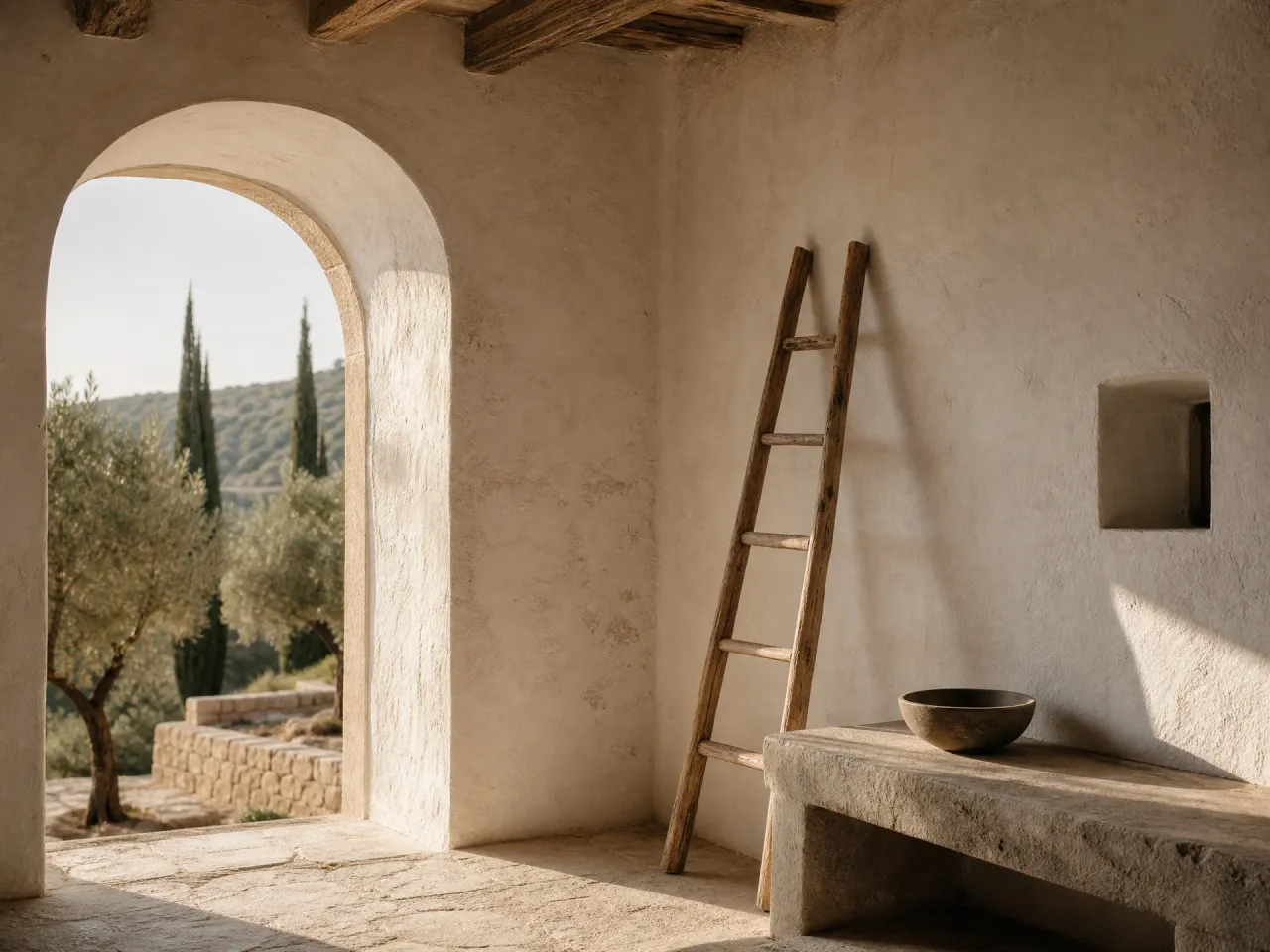
What does lime wash look like?
Three visual properties define the lime-wash look.
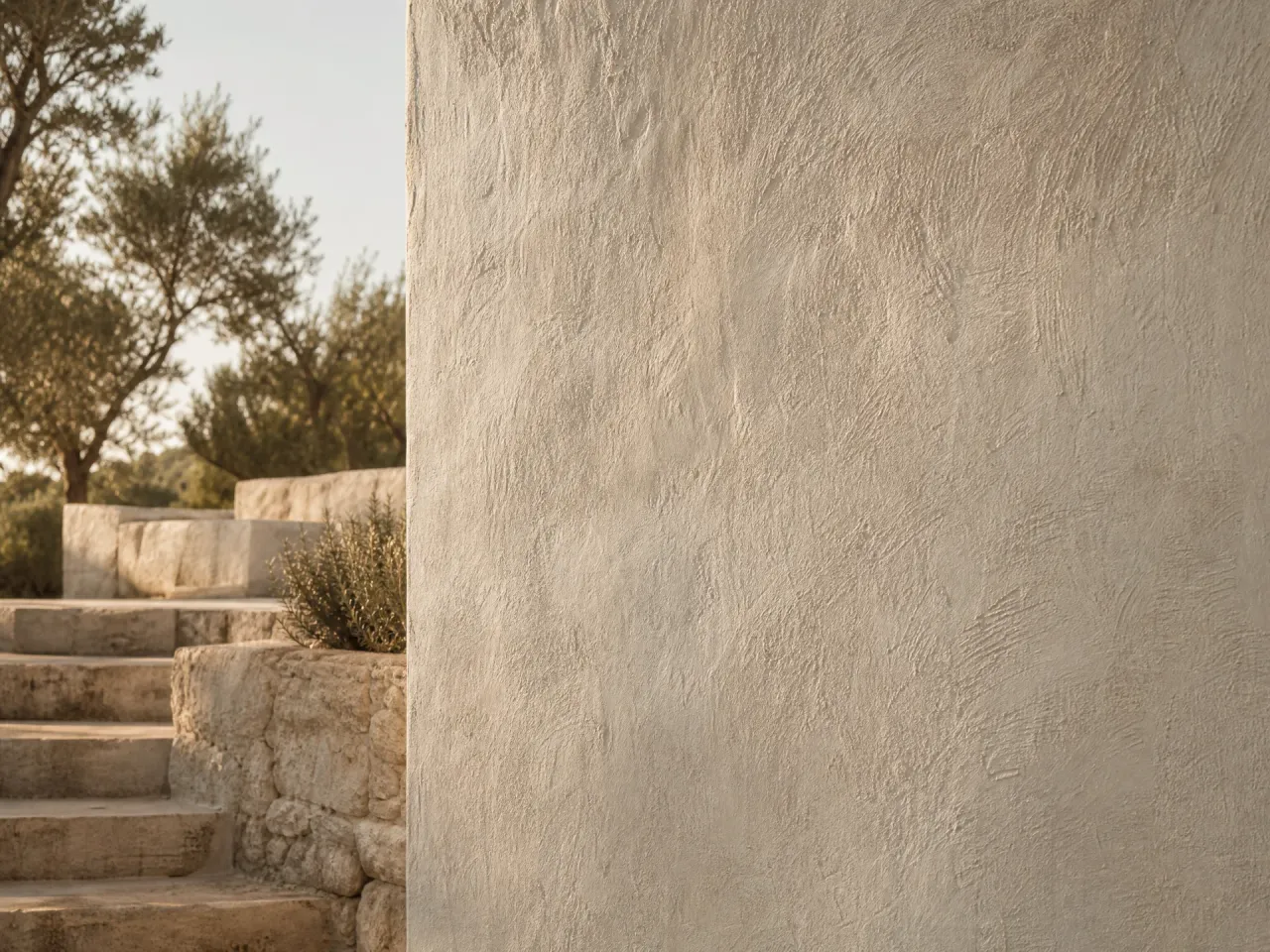
Cloudy depth. Each coat is partially translucent. Five layers of lime wash develop a soft luminous depth that resembles a watercolour wash rather than a flat painted surface.
Movement under light. Because the surface is microscopically uneven and partially translucent, the wall changes colour through the day — warmer at golden hour, cooler at midday, almost violet at dusk. This is the property that photographers and cinematographers prize.
Restricted palette. Natural mineral pigments — iron oxides, ochres, umbers, terre verte — are intrinsically muted. Lime wash cannot be made in a saturated primary colour without synthetic dyes that compromise the chemistry. The palette is the colour of the earth: warm whites, sand, terracotta, bone, dusty pink, soft ochre, charcoal, indigo, terre verte.
How is lime wash applied?
Application is straightforward in principle and skilled in practice. The standard sequence:
- Prepare the substrate. Brush off dust, fix cracks with a lime-compatible filler, and dampen the wall thoroughly with clean water. Lime needs to be applied wet-on-wet onto a damp, absorbent surface.
- Mix the wash. One part slaked lime putty to three parts water, plus pigment (typically 1–5% by weight). Stir thoroughly, leave for 30 minutes, stir again. The mixture should be the consistency of skimmed milk.
- Apply the first coat. Use a long-haired natural-bristle “limewash brush” and work in random cross-hatched strokes. The coat should look almost transparent and very streaky. Resist the urge to make it cover.
- Allow to dry between coats. Typically 4–24 hours depending on humidity and temperature.
- Apply 2–4 more coats. Each coat adds depth and opacity. Most projects need three to five coats total.
- Cure. Full chemical cure takes several weeks. The wall continues to harden for months.
The craft sits in the brush work and the timing. A skilled lime plasterer reads the wall as they apply: drier sections take more material, damper sections refuse it. The result is the characteristic cloudy unevenness — which is the point and what cannot be replicated by an acrylic “lime-look” paint.
How do you maintain a lime-washed wall?
Maintenance is genuinely low — but it is different from paint maintenance.
- Cleaning. Wipe gently with a damp cloth and plain water. Do not use detergent, vinegar, or abrasive cleaners — all will damage the surface.
- Touch-up. A small chip can be patched with a thinned lime wash. The patch will be visible for several months before it weathers in.
- Recoating. Traditional Mediterranean homes are re-lime-washed every 3–10 years on exterior surfaces. Interior surfaces typically last 15–25 years before they need refreshing.
- Furniture marks. Black marks from the back of a sofa or a coat hung on a hook will show. Either accept this — the marks become part of the patina — or use furniture pads.
Crucially, a lime-washed wall is repairable. When an acrylic-painted wall is damaged you generally have to repaint the whole wall to avoid a visible patch. A lime-washed wall accepts a local repair that will, over months, blend invisibly.
What does lime wash cost?
Material cost is low — slaked lime putty is roughly the same price per square metre as a mid-range acrylic emulsion. Labour cost is where the premium sits. Expect to pay 1.5–2.5× the cost of a comparable paint job in skilled-labour markets, because the surface requires more coats, slower drying, and (most importantly) a tradesperson who knows how to apply it. In rural Mediterranean labour markets where lime is a living tradition the multiplier is closer to 1.2×.
For a typical 150 m² Mediterranean villa interior we budget €25–45 per square metre installed for lime plaster plus three to four coats of lime wash. The same wall finished in high-quality acrylic emulsion over plasterboard would cost €15–25 per square metre. Over the life of the building the lime job is cheaper to maintain.
Frequently asked questions
Is lime wash the same as whitewash?
Yes — “whitewash” is the traditional English-language term for lime wash. The two are the same product. “Lime wash” is the term most current architects and conservators use because it is more precise (whitewash technically describes only the unpigmented version).
Can I lime-wash a kitchen or bathroom?
Yes — in fact lime’s mould resistance makes it well suited to humid rooms. Two conditions: the substrate must be a mineral plaster (not plasterboard), and zones that take regular direct water contact (the inside of a shower, the splash zone behind a sink) should be finished with tadelakt — a polished, soap-treated lime plaster — rather than ordinary lime wash. Tadelakt is genuinely waterproof.
Will the colour change over time?
Yes, slowly. Mineral pigments are very stable in the right colour families (earth tones, oxides). Some pigments fade in direct UV — bright synthetic blues, reds, and yellows, none of which we recommend. Within the traditional palette colour shift over ten years is minimal.
Can lime wash be applied over existing paint?
Not directly — lime cannot bond chemically to acrylic film. Two options: strip the paint completely, or apply a mineral-silicate primer designed for the purpose. The second route is more common in renovation and produces an acceptable result, but the wall will no longer be fully breathable.
What about exterior lime wash in cold climates?
Lime wash performs less well in continuously wet, cold, or freeze-thaw conditions. Traditional Mediterranean and southern-European lime washes were developed for hot-dry climates with occasional rain. For exterior use in Northern Europe we typically specify a hydraulic-lime mortar with a tighter chemistry, or a silicate paint as a compatible alternative.
Specifying lime wash on your project
If you are commissioning new work, three notes for the brief:
- Specify lime wash from the start of the design, not as a finishing decision. The wall build-up upstream of the finish has to be designed to breathe.
- Insist that the applicator has built a meaningful body of lime work — not just a portfolio of lime-look acrylics. Ask for two finished projects you can visit in person.
- Accept the look. Lime wash is not paint. If a client insists on a uniform, flat, fully covered colour they would be better served by silicate paint or a high-quality matt emulsion.
Two excellent further resources: the Society for the Protection of Ancient Buildings (SPAB) maintains a guide to traditional lime techniques that remains the standard reference, and the Building Limes Forum publishes technical bulletins worth reading before you specify.
See lime-washed exteriors and interiors in our completed work — including the Koroni villas in the Peloponnese — in our portfolio. To discuss specifying lime on a project of your own, contact La Kruz Atelier.