


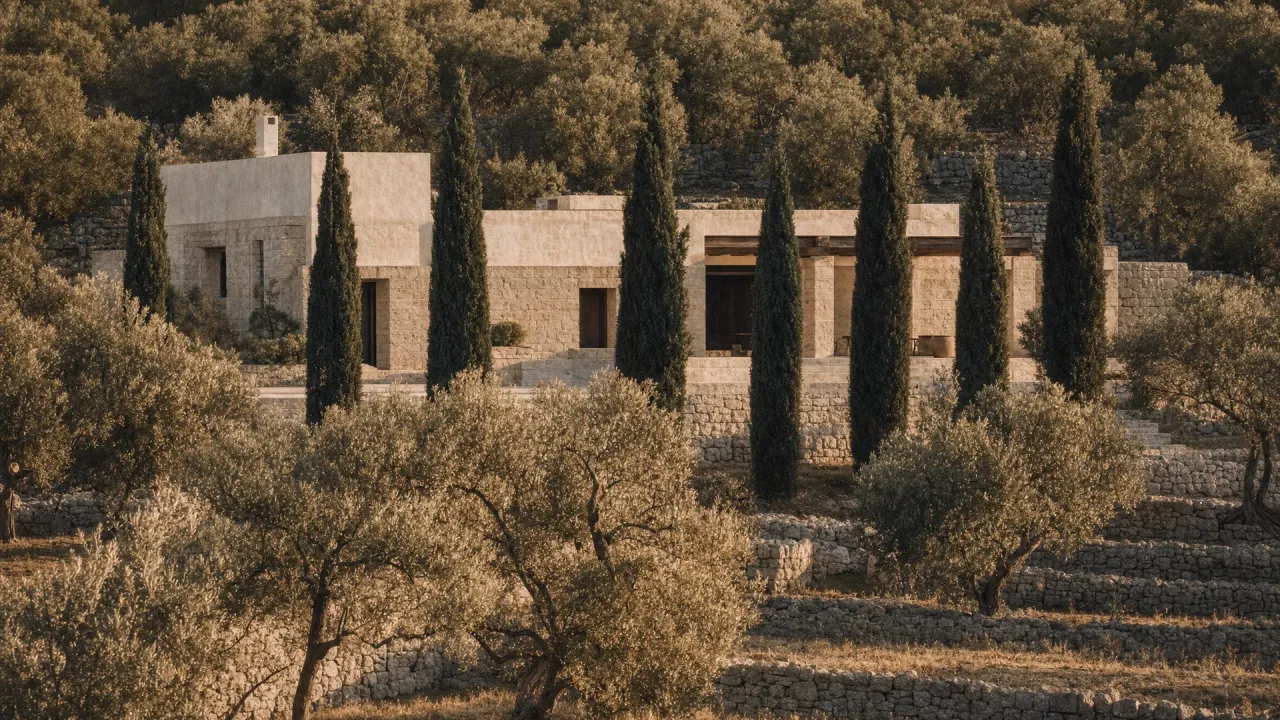
Three plants and one material do most of the work in a Mediterranean landscape: olive trees provide canopy, silver foliage, and human-scale shade; cypress trees provide vertical accent and wind protection; and stone — as walls, paving, and ground — anchors the composition. Used with restraint and correct spacing, this trio produces a landscape that survives 40 °C summers without irrigation, frames architecture instead of competing with it, and grows more beautiful for a hundred years.
At La Kruz Atelier we design landscape and architecture as one project. Most of our exterior briefs begin with the same conversation about these three elements: how many olives, how the cypresses are arranged, where the stone is laid and where the ground is simply gravel. This guide is the longer version of that conversation.
Why olive, cypress, and stone?
The combination is the result of about three thousand years of practical experimentation across the Mediterranean basin. Each element answers a specific environmental and architectural problem.
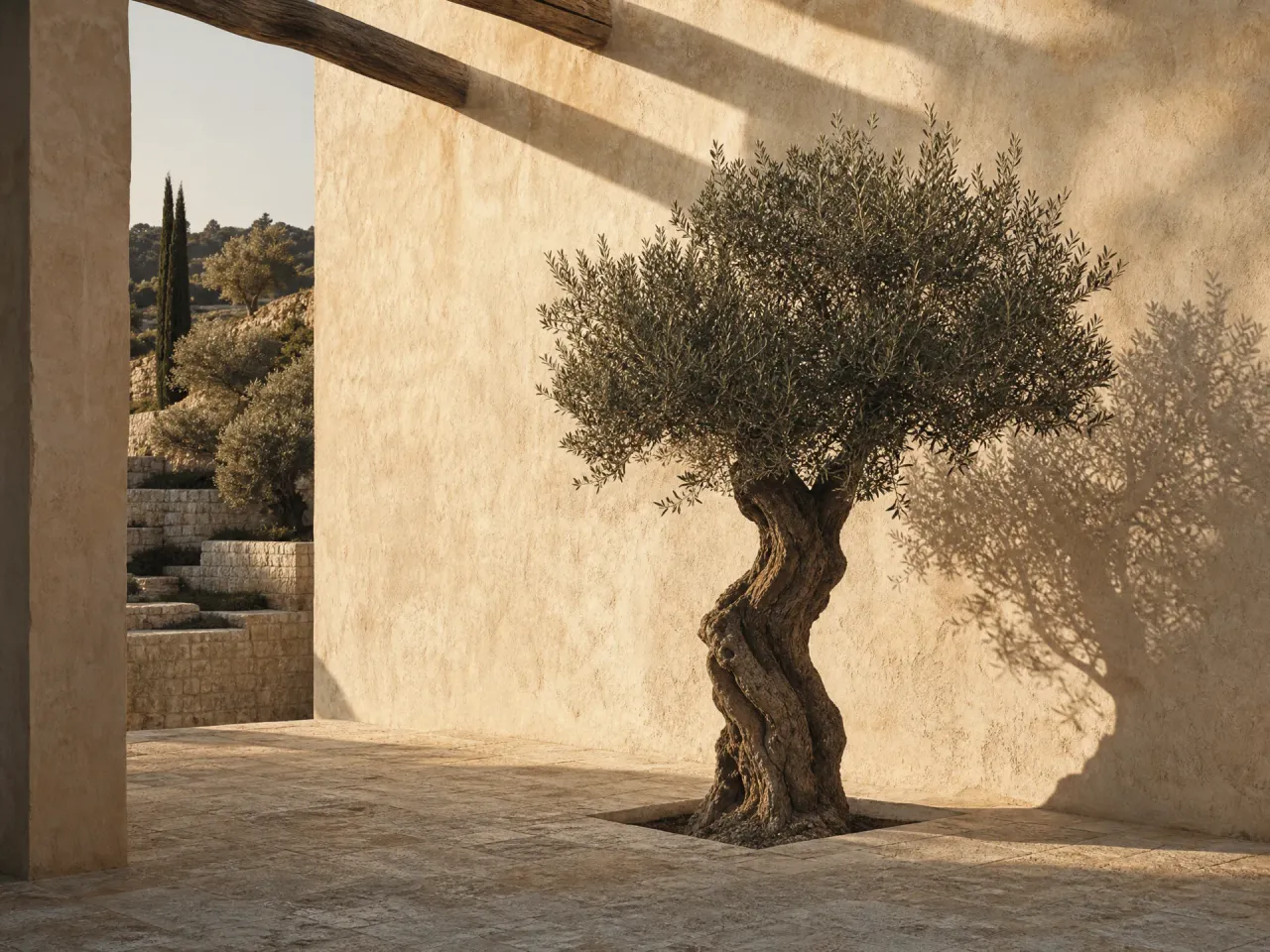
Olive trees tolerate intense summer heat and drought, are evergreen so the landscape never reads as “dead” in winter, live for centuries, and produce a dappled shade that the eye reads as cool. Their silver-grey foliage is a colour rare in plants and a perfect counterpoint to warm-toned stone.
Cypress trees (Cupressus sempervirens, the columnar Italian cypress) grow narrow and tall, cast almost no shadow, and frame views without blocking them. They are the punctuation of a Mediterranean landscape — vertical strokes against a horizontal landscape, used to mark thresholds, entries, axes, and boundaries.
Stone in this climate is the ground, the wall, the path, and the boundary. It accumulates heat in the day and releases it slowly at night, moderating the microclimate. Dry-stone walls in particular host a small ecosystem — lizards, geckos, wild herbs — that brings the landscape alive.
How do you place olive trees in a modern Mediterranean garden?
Three placement rules apply almost universally.
Give them air. A mature olive needs 8–10 m of clear ground in each direction. Plant them too close and they shade each other out, lose their characteristic spreading shape, and produce a mediocre crop if you want fruit. In a courtyard, plan for one mature tree, not three young ones.
Buy mature trees if you can afford to. The bulk of an olive’s character — the gnarled trunk, the asymmetric crown, the venerable presence — accumulates after the tree’s first century. A 60- or 100-year-old olive transplanted to your site (legally — see below) provides in year one what a young tree provides in year fifty. In Italy, Greece, and Spain, mature olives are routinely sold and transplanted with established root balls.
Site them as architectural objects. One mature olive set 4 m off the corner of a stone facade is one of the strongest moves in this aesthetic. Two mature olives flanking a stone path is another. A grid of olives at 8 m centres on a flat terrace is a third. Avoid scattering them randomly across the site; treat each as a placed element.
A note on legality: many Mediterranean countries have strict regulations on uprooting and selling ancient olives because of cultural-heritage concerns. Always buy through a reputable, licensed nursery — never accept “we’ll just lift one from a nearby field.” In Italy in particular this is a serious offence.
How do you use cypress trees in landscape design?
Cypress trees have three traditional landscape roles, and a fourth that has emerged with modern minimalist design.
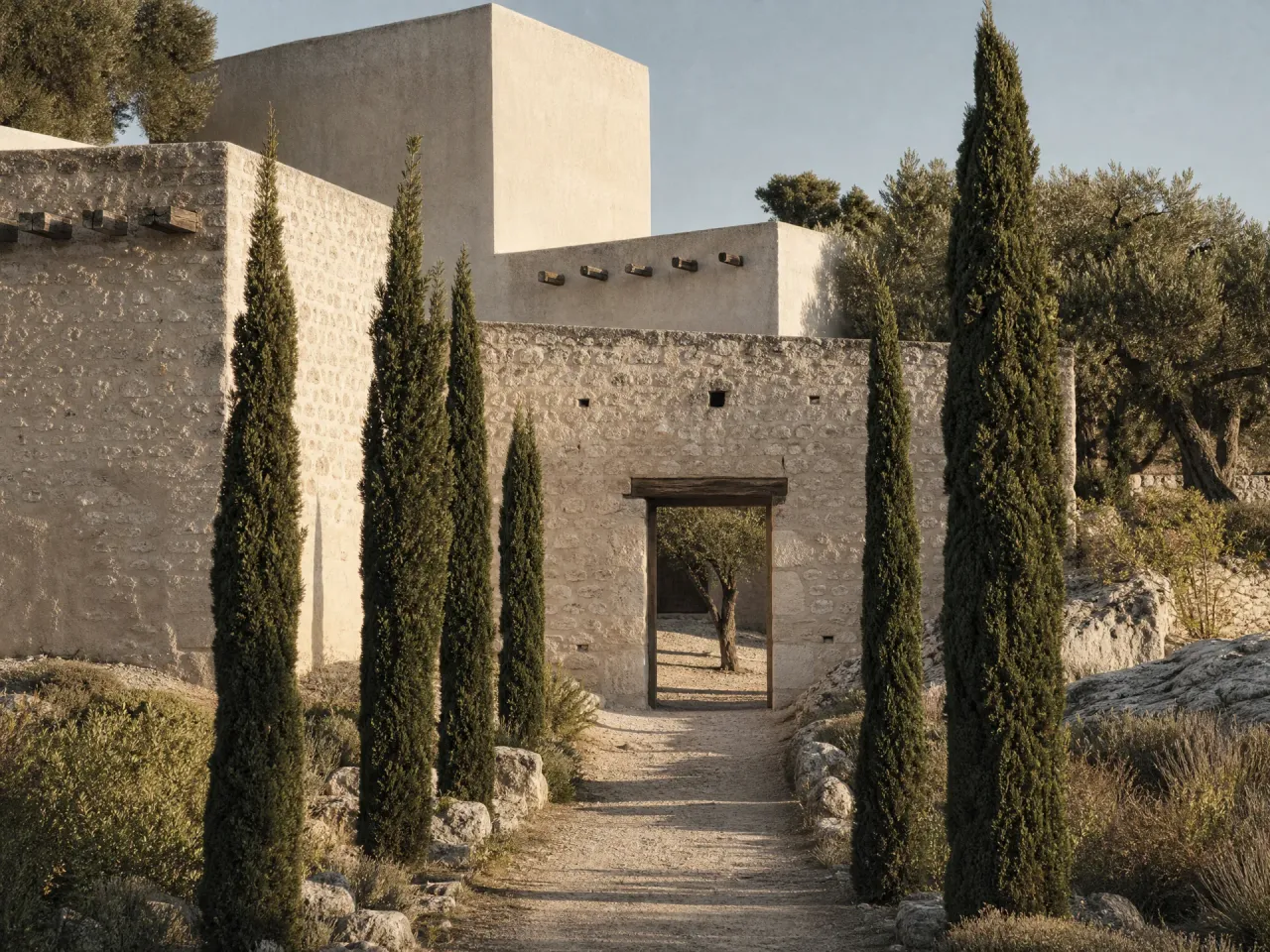
- Avenue. Lined either side of a path, road, or driveway in pairs or staggered pairs. This is the most photogenic configuration and the most overused; use only when the path is long enough (typically 30 m or more) for the rhythm to develop.
- Sentinel. Single trees marking thresholds, gateways, or significant entries.
- Hedge. Planted in a tight row at 1.5–2 m centres and clipped, producing a tall, narrow evergreen screen. Excellent for boundaries and for blocking specific views.
- Counter-mass. Modern use: a single tight cluster of three to five cypresses placed against a long horizontal stone facade, producing a strong vertical accent that “weights” the composition. We use this often in our work.
Two cautions. Cypresses grow taller than expected — a mature tree can exceed 20 m — and they are intolerant of root disturbance once established. Plant them in their permanent positions; once in, they do not move well.
What is the role of stone in the landscape?
Stone in a Mediterranean landscape is rarely decorative; it is structural, functional, and often historic.
Dry-stone retaining walls are the technology that made Mediterranean hillsides habitable. They terrace the slope into level surfaces, manage rainwater, and (incidentally) provide habitat for an extraordinary range of wild plants and small animals. New construction in this language uses the same technique — stone laid without mortar, hand-fitted, and slightly battered (tilted back into the slope).
Stone paving for paths and terraces should usually be the same stone as the building, in a complementary cut. A common detail: large random flagstones with wide gravel joints for primary paths; tight close-jointed stone for entry thresholds; loose gravel everywhere else.
Boundary walls in stone — even quite low ones, 50–80 cm — define rooms in the landscape and produce small sheltered microclimates on their sunny side, where lavender, rosemary, and other Mediterranean herbs thrive.
Water features almost always involve stone. A simple stone trough fed by a single pipe, a flat reflecting basin, a rill cut into the courtyard floor — all use stone and water together to deepen the sense of the landscape.
What other plants belong in a modern Mediterranean garden?
Beyond olive and cypress, a small palette of drought-tolerant Mediterranean plants does the heavy lifting:
- Lavender (Lavandula angustifolia, L. stoechas) — silver foliage, summer flower, scent. Plant in mass, on dry slopes, 60 cm centres.
- Rosemary (Salvia rosmarinus) — evergreen, structural, edible. Excellent low informal hedge.
- Italian stone pine (Pinus pinea) — used singly as a major canopy tree. Long-lived, distinctive umbrella crown.
- Fig (Ficus carica) — small tree, deep shade in summer, deciduous in winter. Perfect for a courtyard.
- Pomegranate (Punica granatum) — small ornamental tree, brilliant flower, fruit.
- Citrus (lemon, bitter orange) — in warmer Mediterranean zones; classic courtyard tree.
- Phlomis (Jerusalem sage) — silver-grey shrub with structural seedheads through autumn.
- Asphodel, sea squill, wild iris — local herbaceous perennials that emerge with the autumn rains and disappear in summer. The garden’s signal of the season.
The palette is short on purpose. The visual logic of the rural Mediterranean landscape is repetition — a hillside of olives, a band of lavender, a row of cypress. Importing many species defeats that logic and produces something that reads as a horticultural collection rather than a Mediterranean landscape.
What about irrigation, lawn, and water?
Three positions we hold firmly.
No lawn. A lawn is the single most water-hungry element you can put on a Mediterranean property and visually it does not belong in this aesthetic. Replace it with gravel, planted ground cover, or simply the bare baked earth that traditional Mediterranean courtyards used.
Drip irrigation only. Established Mediterranean plants need almost no water once they are in. New plantings need targeted drip irrigation for the first two summers and almost nothing thereafter. Overhead spray systems waste water and encourage shallow rooting.
Catch the rain. A simple cistern fed from the roof captures enough rainfall in a typical Mediterranean year to cover all garden irrigation needs. Specify the cistern at the building stage; retrofitting is expensive.
How do you integrate landscape with architecture?
The most successful Mediterranean projects treat landscape and architecture as one continuous design. A few moves consistently work:
- Pull the building into the landscape. Run a stone wall from the house out into the garden. Continue the floor material into the loggia and out onto the terrace. Make the threshold ambiguous.
- Plant against the architecture, not in front of it. One mature olive 1.5 m from a long stone wall produces a beautiful composition; a row of olives down the middle of the same view does not.
- Use levels. Mediterranean landscapes are rarely flat. Terracing the site with dry-stone walls produces a series of outdoor rooms at different levels, each with its own microclimate.
- Frame views, don’t fill them. A row of cypresses can hide a neighbouring building you don’t want to see. The same row can frame a view of the sea or a distant chapel.
- Quiet the foreground. Closer to the house, the landscape should be calmer — gravel, paved courtyard, a single tree. Save the visual complexity for the middle distance and beyond.
Frequently asked questions
How long does it take to establish a Mediterranean landscape?
Cypress trees reach a useful size in 5–8 years from a 1.5 m sapling. Olive trees from a sapling take 15–25 years to look established; mature transplanted trees give the look immediately. Lavender and rosemary fill in within two seasons. A garden planted from young stock looks “complete” at year 5 and excellent at year 10.
Can I grow this style of garden outside the Mediterranean?
The look can be approximated in any hot-summer dry climate — interior California, parts of inland Australia, the South African Western Cape, the high Andean valleys, parts of the Levant. Olives and cypresses tolerate USDA zones 8 and warmer. In wet or cold climates the same garden will not perform: the plants are not adapted and the visual quality (silver-grey, dry, sparse) does not read as “right” against lush vegetation.
How much does a designed Mediterranean landscape cost?
For a 1500 m² landscape with several mature olives, a cypress accent, dry-stone walls, gravel paving, and an integrated irrigation system, expect €40–120 per square metre depending on the cost of mature plant material and stone in your region. Mature olive trees can range from €600 to €15,000 each.
Do olive trees need pruning?
Productive (fruit-bearing) olives need annual pruning to open the crown and concentrate fruit. Purely ornamental olives can be left far more naturally — a light annual shape pruning is enough. We generally prune for shape, not for yield, on residential projects.
What lighting works in a Mediterranean landscape?
Low and warm. Inground uplights at the base of selected olive and cypress trees produce most of the night effect. Path lighting should be recessed and barely visible. Avoid spotlights mounted at high level — the desert-clear summer sky is one of the strongest visual elements of a Mediterranean site and over-lighting destroys it.
Designing the landscape around your project
The cheapest version of this advice: if you are building in a Mediterranean climate, design the landscape before the house is finished, not after. Most of the cost-effective moves — terracing, retaining walls, mature trees in their permanent positions — are far easier to install while the site is open.
Two further resources we recommend: the Mediterranean Garden Society publishes excellent material on plant palette and water-wise design; the Olivier de Serres French school maintains a long tradition of writing on Mediterranean horticulture.
Built examples of integrated architecture-and-landscape design from our practice — particularly the Koroni and Paracuru villas — are in our portfolio. To discuss a landscape-led project, contact La Kruz Atelier.